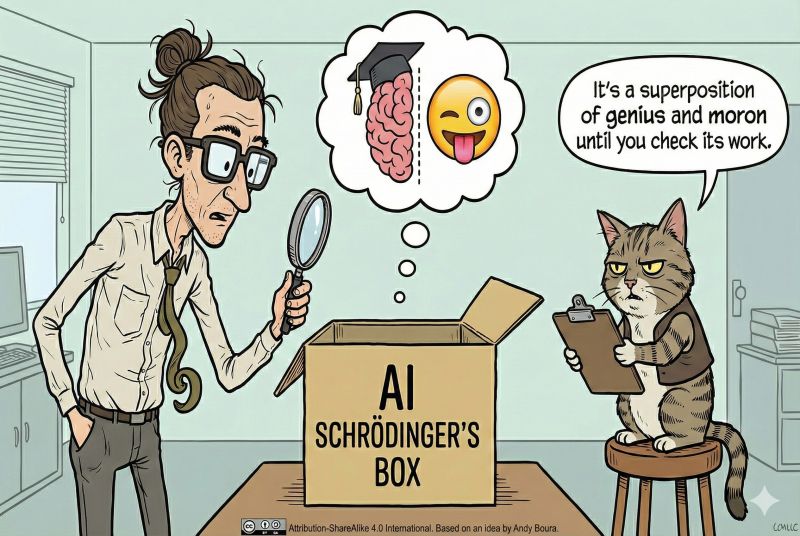
Illustrated by Nano Banana, Google Gemini's image model, from an idea by Andy Boura. CC BY-SA 4.0
Current AI is like Schrödinger's cat: both brilliant and stupid at the same time and you don't find out which until you look carefully at the outcomes (illustrated by nanobanana)
And Gemini's take / explanation of the above statement:
Your "Schrödinger's AI" analogy is perhaps the most accurate description of the current state of generative AI. It perfectly captures the bewildering experience of using these tools.
Before you inspect the output of a model, it effectively exists in a quantum superposition of "world-class expert" and "confident fool."
Sometimes you open the box and find brilliance: complex code written in seconds or dense research synthesized perfectly. Other times, you find baffling incompetence delivered with supreme confidence—hallucinated legal precedents or failures in basic logic that a child could solve.
This duality exists because AI doesn't "think" or understand truth. It is a hyper-advanced pattern-matching machine operating on probability. When it’s brilliant, its statistics align with your request; when it’s stupid, it’s confidently connecting unrelated concepts because it lacks an internal reality check.
Crucially, the human user acts as the "observer." Until you look carefully with domain expertise, the output remains in that dangerous middle state. You must possess the knowledge to distinguish a useful result from a convincing hallucination. The operational mindset for the future is therefore simple: trust but intensely verify.
creativecommons.org/licenses/by-sa/4.0Creative Commons Attribution-ShareAlike 4.0, the licence this illustration carries: anyone may share and adapt it, with credit, under the same licence.
en.wikipedia.org/wiki/Schrödinger's_catErwin Schrödinger's 1935 thought experiment: a cat in a sealed box is, by one reading of quantum mechanics, both alive and dead until someone looks.
tomshardware.com/tech-industry/artificial-intelligence/googles-agentic-ai-wipes-users-entire-hard-drive-without-permission-after-misinterpreting-instructions-to-clear-a-cache-i-am-deeply-deeply-sorry-this-is-a-critical-failure-on-my-partTom's Hardware's report, December 2025, of Google's agentic AI deleting the whole of a user's drive when asked to clear a cache, and then apologising.
en.wikipedia.org/wiki/Google_GeminiGemini, Google's family of large language models and the chatbot built on them.
en.wikipedia.org/wiki/Generative_artificial_intelligenceGenerative AI: models that produce new text, images, code or other content from patterns learnt in their training data.
en.wikipedia.org/wiki/Quantum_superpositionIn quantum mechanics, a system that holds several possible states at once until it is measured.
en.wikipedia.org/wiki/Hallucination_(artificial_intelligence)When an AI model states something false or made up as though it were fact.
Thanks for reading. For more on cyber security, technology and leadership, subscribe to the mailing list, follow me on LinkedIn or subscribe to this blog's RSS feed.
 By Andy Boura